- April 9, 2026
- Artificial Intelligence
Healthcare is entering a new era of artificial intelligence. From clinical decision support to predictive diagnostics and operational automation, AI has the potential to dramatically improve patient outcomes and healthcare efficiency.
But there is a major challenge.
Healthcare data is among the most sensitive data in the world. Hospitals, clinics, pathology labs, insurers, and digital health providers all operate under strict privacy, security, and compliance requirements. This makes traditional centralized AI models difficult to scale safely across organisations.
That is where Decentralized AI (DeAI) and Blockchain come in.
At Idea2Network, we believe the future of healthcare AI will not be built on blind centralisation. It will be built on privacy-first, auditable, collaborative, and trust-driven architectures that allow innovation without compromising patient data.
The Problem with Traditional Centralized AI in Healthcare
Most AI systems rely on collecting and centralising data in one place. In healthcare, this approach creates serious concerns:
- patient privacy risks
- regulatory and compliance complexity
- reluctance to share sensitive data across institutions
- increased cybersecurity exposure
- limited trust between healthcare stakeholders
Hospitals may want the benefits of AI, but they do not want to lose control of sensitive Electronic Health Records, medical imaging, pathology reports, or diagnostic data.
This creates a barrier to large-scale collaboration, especially when multiple healthcare providers could collectively improve AI outcomes but cannot safely pool raw data.
What is Decentralized AI in Healthcare?
Decentralized AI allows healthcare organisations to collaborate on AI model training without sending raw patient data to a central repository.
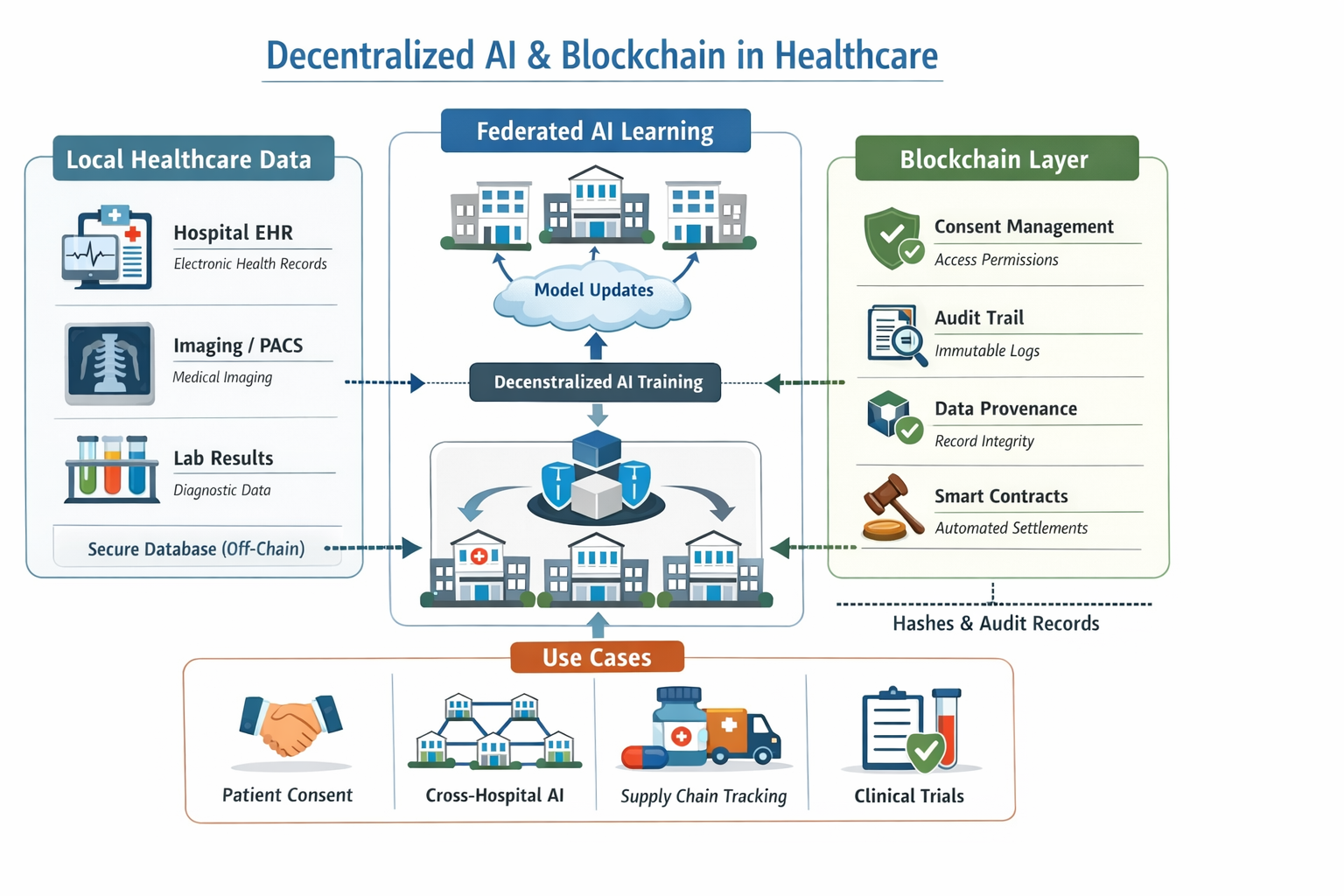
Using approaches such as federated learning, hospitals and healthcare providers can train AI models locally within their own secure environments. Instead of sharing the data itself, they share only model updates.
This means:
- patient records remain within the hospital or healthcare provider
- institutions retain greater data sovereignty
- AI models improve through collaboration
- privacy and governance are significantly strengthened
In simple terms, the AI goes to the data — the data does not need to leave its secure home.
Where Blockchain Fits In
While Decentralized AI solves part of the problem, healthcare also needs a trusted coordination layer. That is where blockchain adds value.
Blockchain can help healthcare organisations create a secure and transparent framework for:
Consent Management
Patients can have clearer, trackable permissions over how their data is used. Consent records can be securely managed and verified.
Audit Trails
Every access request, update, approval, or AI-related interaction can be recorded in an immutable audit trail.
Data Provenance
Healthcare organisations can verify where data came from, how it was used, and whether it has been altered.
Smart Contracts
Processes such as data-sharing agreements, research workflows, and automated settlements can be governed by programmable rules.
Blockchain does not replace secure healthcare databases. Instead, it works alongside them as a trust and verification layer.
Why This Matters for the Medical Industry
The medical industry is under pressure to innovate, but also to remain compliant, secure, and ethical.
A DeAI plus blockchain architecture gives healthcare organisations a way to modernise responsibly.
The benefits include:
- stronger patient privacy
- improved trust in AI systems
- reduced risk from centralised data exposure
- better compliance and governance
- more secure collaboration across hospitals and institutions
- improved transparency for regulators, partners, and patients
This is especially important as healthcare organisations look to use AI in areas such as diagnostics, research, operations, and clinical support.
Real-World Use Cases in Healthcare
1. Cross-Hospital AI Training
Multiple hospitals can collaboratively train models for diagnostics or risk prediction while keeping patient data local.
2. Patient Consent Management
Blockchain-based consent records can provide clear and auditable permissions around data access and AI usage.
3. Clinical Trials
Research organisations can improve trust, traceability, and integrity across trial data, approvals, and participant records.
4. Medical Supply Chain Tracking
Medicines, devices, and medical supplies can be tracked with better transparency and verification.
5. Audit-Ready Healthcare Data Governance
Healthcare providers can create systems that are easier to review, monitor, and validate from a compliance perspective.
Why Bespoke Architecture Matters
There is no one-size-fits-all solution in healthcare.
Every organisation has different:
- systems and integrations
- compliance obligations
- security models
- data maturity levels
- research goals
- clinical workflows
That is why healthcare innovation should not start with a generic platform purchase. It should start with the right architecture.
At Idea2Network, we work with organisations to design bespoke DeAI and blockchain implementation strategies aligned to their real operational, technical, and regulatory environment.
We help turn emerging concepts into practical solutions that fit business reality.
How Idea2Network Can Help
We can support healthcare organisations with:
- DeAI strategy and solution design
- federated learning architecture
- blockchain trust layer design
- secure healthcare data workflows
- AI governance and audit architecture
- proof of concept and bespoke implementation roadmaps
Whether you are a hospital, digital health platform, medical startup, research organisation, or healthcare technology leader, this space offers a major opportunity to build smarter and more trusted systems.
The Future of Healthcare AI
The next generation of healthcare AI will not simply be judged on performance.
It will be judged on:
- privacy
- trust
- transparency
- explainability
- compliance
- security
The winners in this space will be the organisations that build AI systems patients, clinicians, and regulators can trust.
Decentralized AI and blockchain offer a path to that future.
Let’s Build It Together
If your organisation is exploring AI in healthcare and wants to do it in a way that is secure, compliant, and future-ready, Idea2Network can help.
Visit idea2network.ai to discuss a bespoke healthcare and blockchain solutions tailored to your organisation.