- April 12, 2026
- Artificial Intelligence, Business, Natural Language Processing, Technology
Take a look at your company’s current software stack. Over the last decade, businesses have adopted a new application for almost every operational challenge – accumulating endless SaaS subscriptions, rigid dashboards, and siloed databases. Yet, despite this massive digital investment, your team is likely still drowning in manual tasks, copying data between windows, and acting as the “glue” between disconnected apps.
Why? Because traditional software doesn’t actually do the work. It simply provides a digital workspace for humans to do the work more easily.
But a massive paradigm shift is currently underway. The rise of AI agents in business is transforming software from a passive tool into an active, independent worker. Here is why autonomous systems are making traditional software obsolete, and how forward-thinking leaders are using them to build leaner, highly scalable operations.
What Exactly Are AI Agents?
If you have used ChatGPT, you have used an AI copilot – a system that waits for your prompt, gives you an answer, and stops. It requires constant human direction.
An AI agent, on the other hand, is an autonomous system capable of understanding an overarching goal, planning the necessary steps, using software tools to execute those steps, and adapting when it hits roadblocks. You don’t prompt an agent step-by-step. You give it an objective, like “Process all incoming refund requests according to our policy,” and it handles the rest.
Why Traditional Software is Becoming Outdated
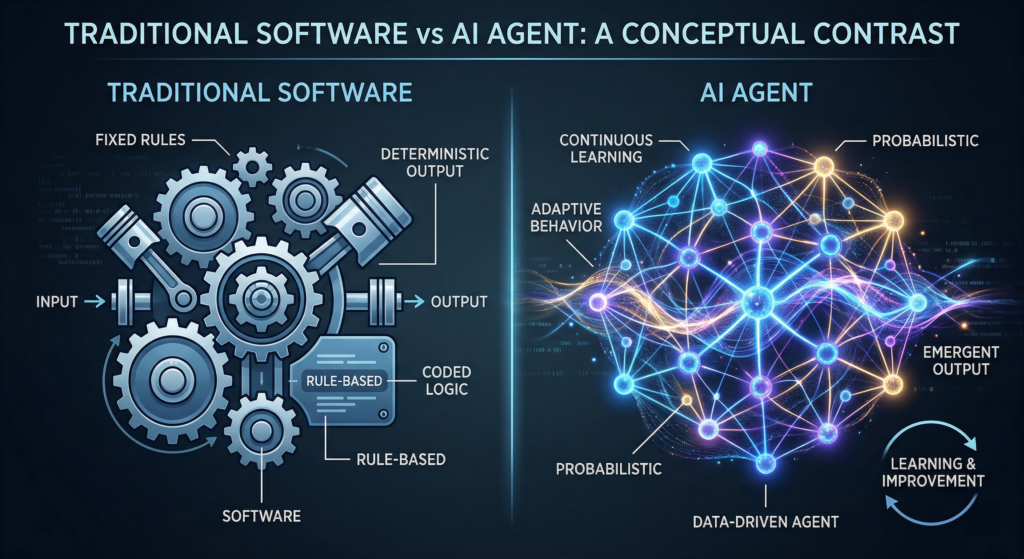
Traditional software relies on deterministic, rule-based logic: If X happens, then do Y.
This works perfectly for predictable tasks, but business is rarely perfectly predictable. When a traditional workflow engine encounters a misspelled name, a missing invoice number, or a unique customer complaint, the automation breaks. A human has to step in, resolve the exception, and restart the process.
AI agents replace brittle “if-then” rules with reasoning. Because they are powered by Large Language Models (LLMs), agents can understand context, interpret unstructured data (like messy emails or phone transcripts), and make logical decisions on the fly. They don’t just route information; they create intelligent workflows that adapt to the messy reality of daily operations.
How AI Agents Work in a Business Context
To understand how agents operate without getting bogged down in technical jargon, think of them as having three core components:
- The Brain (Reasoning): The core AI model that understands language, analyzes context, and decides what actions to take.
- The Memory (Context): The ability to remember past interactions, company policies, customer histories, and ongoing tasks.
- The Hands (Tools & APIs): The integrations that allow the agent to actually do things – like query a CRM, send emails, generate invoices in Xero, or update a database.
When these three elements are combined, you get true AI automation – a system that perceives a problem, figures out how to solve it using your company’s existing tools, and executes the solution.

Real-World Business Use Cases
How does this look in practice? Across industries, business AI is moving out of the lab and into the operational frontline:
- Customer Service: Instead of a frustrating chatbot that deflects users to an FAQ page, an AI agent can read a customer’s email, check their order status in Shopify, realize their package was delayed by the courier, issue a partial credit according to company policy, and send a personalized apology email – all without human intervention.
- Hospitality & Restaurants: An autonomous agent can manage high-volume voice and digital reservations, intelligently negotiate seating times to maximize floor capacity, answer complex menu questions regarding allergens, and coordinate directly with inventory systems to anticipate stock needs.
- Operations & Supply Chain: An agent can monitor hundreds of supplier emails, extract updated delivery dates, cross-reference them against production schedules, and automatically flag (and propose solutions for) any incoming bottlenecks.
- Finance & Accounting: Instead of manually matching invoices, an agent can ingest PDFs in various formats, reconcile them against purchase orders, identify billing discrepancies, and queue approved payments for a human manager’s final sign-off.
The Strategic Benefits for Businesses
Implementing AI agents goes far beyond simple cost-cutting. It fundamentally changes the economic physics of your business:
- Infinite Scalability: Whether you receive 10 customer inquiries today or 10,000 tomorrow, an autonomous system scales instantly to meet the demand without requiring you to hire, train, or manage temporary staff.
- Always-On Execution: Agents don’t sleep, take holidays, or suffer from burnout. They execute critical operational tasks 24/7 with consistent precision.
- Unlocking Human Capital: When you remove the burden of repetitive data entry and micro-decisions, your human team can finally focus on what they do best: high-level strategy, relationship building, and complex problem-solving.
The Risks: Why You Can’t Just “Plug and Play”
While the potential is massive, deploying AI agents requires careful strategic planning. If an agent is given too much autonomy without the right guardrails, it can make costly mistakes.
Security and access control are paramount. You must ensure that an agent only has the permissions necessary for its specific role. Furthermore, AI models can still “hallucinate” or make poor judgments if they are fed bad data. Successful implementation requires a “human-in-the-loop” design, where the agent handles 90% of the heavy lifting but routes high-stakes decisions to human managers for approval.
Why Custom, Bespoke AI Solutions Matter
Because of these complexities, off-the-shelf AI wrappers rarely deliver true operational transformation. Your business has unique workflows, proprietary data, and specific security requirements.
Generic AI software doesn’t know how your specific sales team qualifies a lead, or the nuances of your internal fulfillment process. To get the real ROI of autonomous systems, you need a bespoke architecture built around your exact operational reality.
Step Into the Future of Work with Idea2Network
The shift from passive software to proactive AI agents is not a distant future – it is happening right now. Companies that adopt autonomous workflows today will operate faster, leaner, and more profitably than their competitors tomorrow.
At Idea2Network, we specialize in designing and deploying secure, custom AI agents tailored to your unique business environment. We don’t just sell software; we build intelligent systems that work for you.
Ready to stop managing software and start automating your operations? Contact Idea2Network today to schedule a consultation, and let’s discuss how we can build the perfect AI workforce for your business.