- May 26, 2026
- Artificial Intelligence, Business
AI cost optimization is becoming a priority for enterprise teams as adoption grows quickly and API and inference costs rise just as fast.
The question is no longer simply, “Which model is the most powerful?” The better question is: how do we scale AI without using the most expensive model for every task?
This is where AI cost optimization becomes a strategic architecture decision, not just a procurement exercise. Most enterprise AI workloads do not need premium reasoning on every request. Many tasks can be handled by smaller, cheaper or open models without reducing business value.
Why AI Cost Optimization Matters for Enterprise Teams
Fast-growing AI platforms usually start with a simple approach: send everything to the strongest available model. That works well during experimentation, but it becomes expensive at scale.
As usage increases, the cost drivers become clearer. High-volume summarisation, extraction, classification, support triage, data enrichment and content transformation tasks can generate thousands or millions of model calls. If every request goes to a premium model, operating costs can rise faster than the value created.
Not Every AI Workload Needs a Premium Model
A practical AI cost optimization strategy starts by separating workloads by complexity. Some tasks need advanced reasoning, deeper context handling and stronger reliability. Others simply need fast, low-cost inference.
- Bulk or simple tasks can often run on cheaper open models.
- Complex reasoning tasks should be routed to premium models only when needed.
- Repeated production workflows should be measured, benchmarked and continuously optimized.
Two Practical Ways to Test Cheaper AI Models
1. DeepSeek API or OpenRouter
For rapid experimentation, DeepSeek and OpenRouter provide a fast way to test lower-cost model options without building infrastructure first.
This is often the cheapest path for bulk AI tasks, early benchmarking and workload routing experiments. Teams can compare latency, quality and cost before making bigger architectural decisions.
2. NVIDIA Model Playground
The NVIDIA Model Playground is useful for stress-testing models such as Qwen, Llama and other open models against real production-style prompts.
Before investing in GPU hardware, enterprise teams should understand which workloads actually benefit from self-hosting, dedicated infrastructure or GPU appliances.
Where Is Your AI Spend Really Going?
Before buying more infrastructure, the first step is visibility. Teams need to understand where AI spend is being consumed across models, users, products and workflows.
- Which models are consuming the most budget?
- Which workloads truly require premium reasoning?
- Which tasks can move to cheaper or open models?
- Which workflows have predictable, high-volume inference demand?
Once those answers are clear, a hybrid AI architecture starts to make financial sense.
AI Cost Optimization Through Hybrid AI Architecture
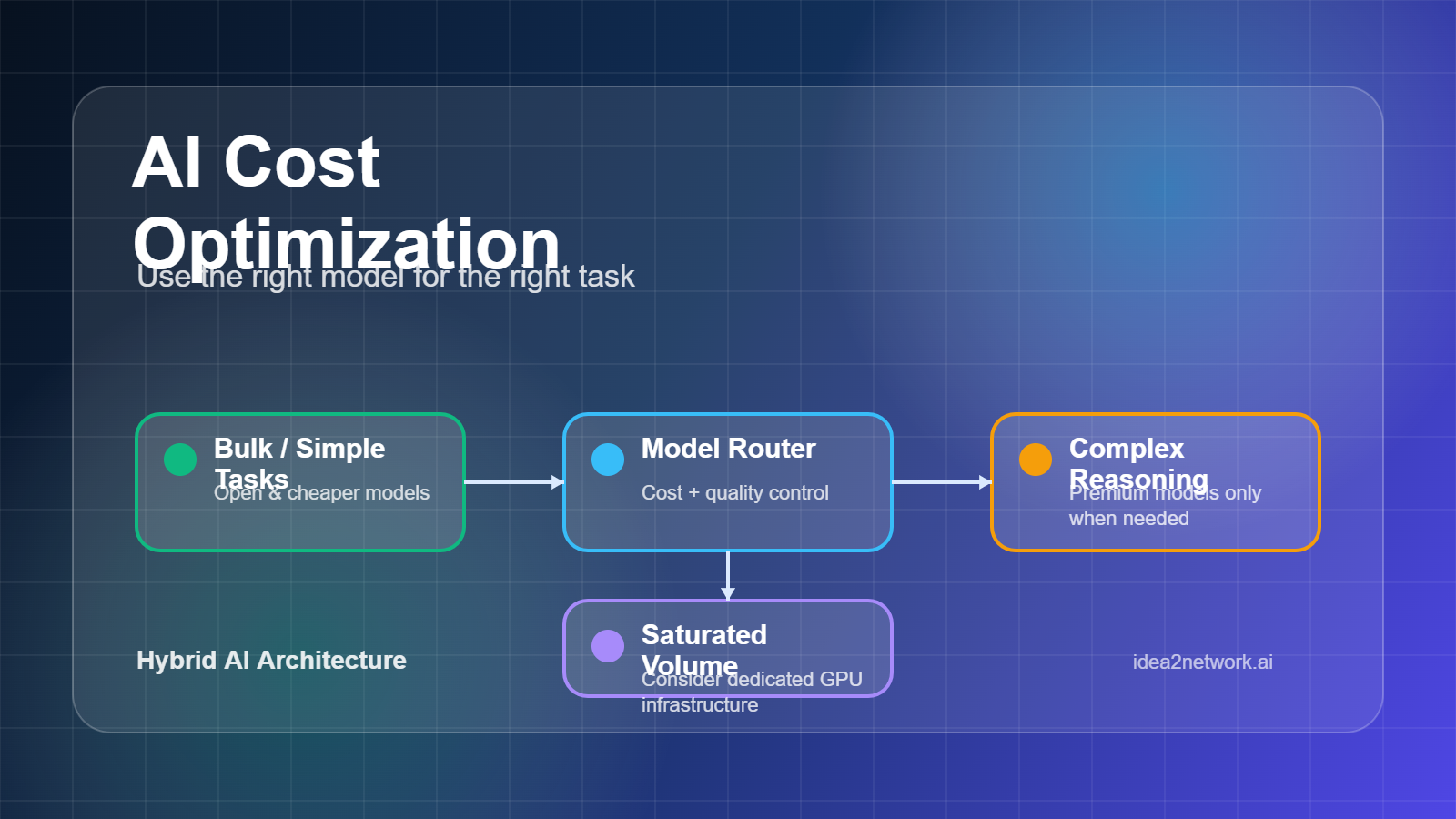
My view is that many organisations can likely reduce AI operating costs by 60–80% by routing workloads more intelligently.
- Bulk and simple tasks should go to cheaper open models where quality is sufficient.
- Complex reasoning should go to premium models only when the workload justifies it.
- Saturated high-volume inference may justify dedicated infrastructure over time.
If cloud inference volume remains consistently saturated after optimization, systems such as NVIDIA DGX Spark can become financially justifiable as a long-term infrastructure investment.
The Future Is Right Model, Right Task
The future of enterprise AI is not: “Use the biggest model for everything.”
It is: use the right model for the right task.
That mindset turns AI cost optimization into a competitive advantage. Enterprises that measure usage, benchmark models and route workloads intelligently will be better positioned to scale AI sustainably.
At Idea2Network, this is exactly the kind of architecture thinking we believe will define the next phase of enterprise AI adoption.